
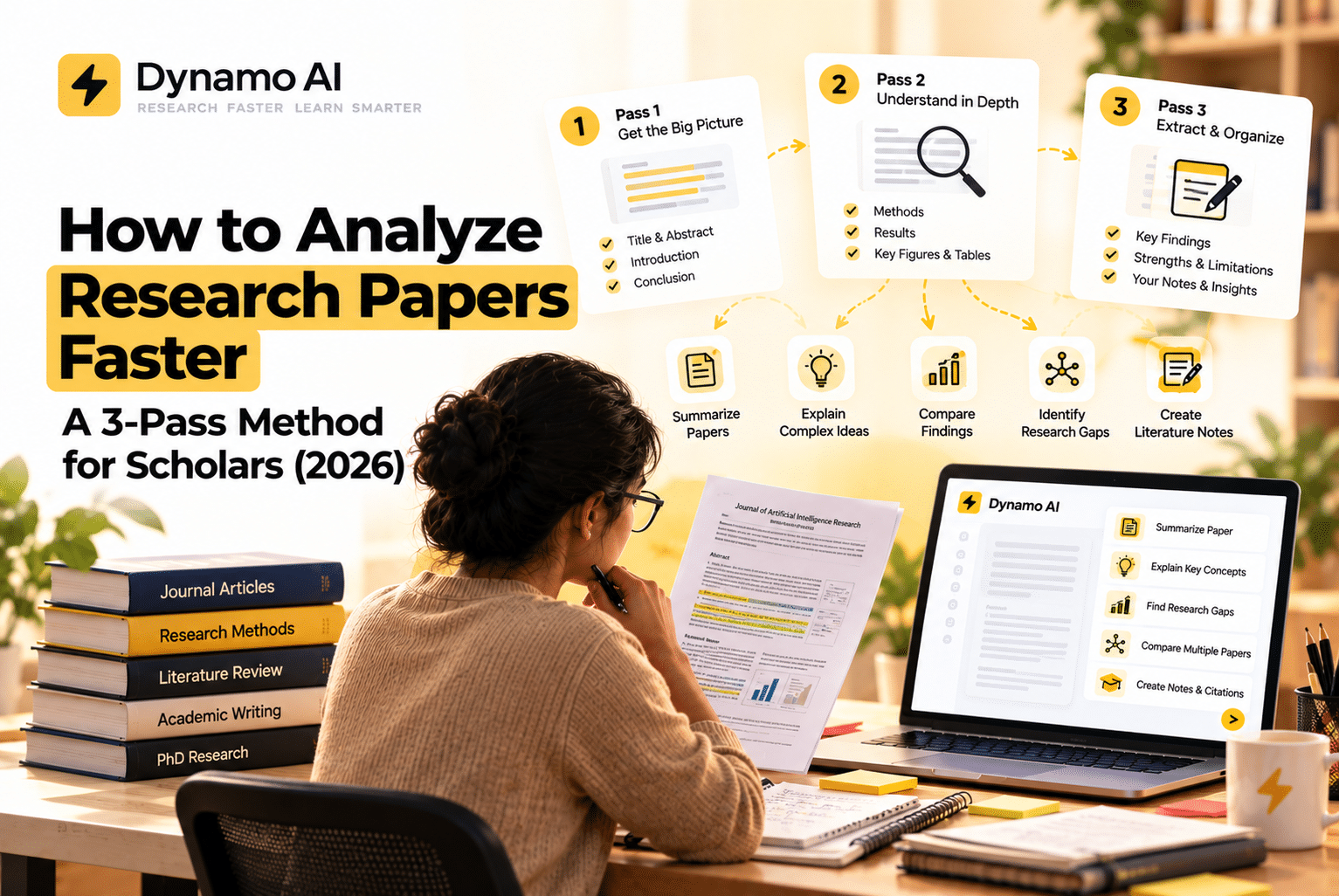
Quick answer: To analyze research papers faster, do not read them from start to finish. Use three passes: first, skim the title, abstract, headings, and conclusion (5 to 10 minutes) to decide if the paper matters; then read the introduction, figures, and methods for understanding (about 30 minutes); then read in depth only the few papers central to your work. Record the same notes for every paper so you can compare them later.
By AnishKrisna, Founder of Dynamo AI | 11 years in data analytics | Last updated: October 2026
Part of our complete series: How to Write a Research Paper: A 9-Step Guide
Why Reading Papers Feels So Slow
Most students read every paper like a textbook: from the first line to the last. A literature review may need 40 to 100 papers, so this approach quickly becomes impossible.
Experienced researchers do not read more words. They read in layers, decide early what deserves attention, and capture what they learn in a consistent format. This guide shows how to do the same.
It fits into the larger process described in our literature review guide.
The 3-Pass Method
This approach is based on a well-known method for reading papers, often attributed to S. Keshav, and works for most academic fields.
Pass 1: Triage (5 to 10 minutes)
The goal is to decide whether the paper deserves more time.
Read only:
- Title and abstract
- Headings and subheadings
- Introduction (first and last paragraphs)
- Conclusion
- Quick glance at figures and tables
Then answer:
- What is this paper about?
- Is it relevant to my research question?
- Is the source credible (peer-reviewed, recognised journal, recent)?
Sort the paper into one of three bins: discard, keep for later, or read in full. Most papers will land in the first two.
Pass 2: Understand (30 to 60 minutes)
For papers you keep, read more carefully, but still skip details.
Focus on:
- The research question and hypothesis
- The methods: sample, data, tools, and analysis
- The figures and tables, which often carry the main results
- The limitations
Skip dense proofs, long background sections, and statistical details unless they matter to you. Note references that look important and add them to your reading list.
Pass 3: Deep Read (1 to 3 hours)
Reserve this for the 5 to 10 papers central to your work, such as the ones your study builds on, challenges, or replicates.
Here you check whether the argument holds. Ask:
- Are the methods appropriate for the question?
- Do the data support the conclusions?
- What would I do differently?
- What did the authors not address?
In my experience, I first check the research abstract; if it is fully explainable, then I only check the rest, so get your research abstract correct.
A Better Reading Order for Empirical Papers
Papers are written in order, but they are not read best in that order. Try this sequence:
- Abstract: the overall summary
- Conclusion: the answer, so you know where the paper ends up
- Figures and tables: the evidence, quickly
- Introduction: the gap and the research question
- Methods: how they did it
- Discussion and limitations: what it means and what is missing
Reading the conclusion early gives you a map, so every later section is easier to place.
The 6-Question Note Template
For every paper you keep, answer the same six questions in one place, such as a spreadsheet or a reference manager like Zotero or Mendeley.
- What question does it ask?
- What method and sample does it use?
- What are the main findings?
- What are the limitations?
- How does it relate to my topic?
- Which theme or group does it belong to?
Keep each answer to one or two lines. The goal is a short, comparable record, not a mini-essay.
This is the same structure used to build a literature matrix, which also helps you find a research gap.
7 Habits That Make You Faster
1. Read with a question in mind. Before opening a paper, write down what you need from it. Reading with a purpose cuts wasted time.
2. Time-box your reading. Give each Pass 1 only 10 minutes and each Pass 2 about an hour. Limits stop you from over-reading low-value papers.
3. Batch by theme. Read all papers on one sub-topic together. Patterns and contradictions are easier to spot when the papers are fresh in your mind.
4. Start with reviews. One good review article summarises dozens of studies and points you to the key ones.
5. Use the reference list as a map. Papers cited by many other papers are usually foundational. Read those first.
6. Annotate as you read. Highlight only what answers your six questions. Highlighting everything means highlighting nothing.
7. Stop when you see repetition. If new papers keep repeating the same points, you have probably covered that theme.
Reading the Parts That Are Hard
Methods and statistics: You do not need to master every test. Focus on whether the sample is adequate, the measures are valid, and the conclusions match the data.
Technical terms: Keep a running glossary. After a few papers, the vocabulary repeats.
Long papers: Read the abstract, headings, conclusion, and figures first. Then dive into only the sections that serve your question.
Using AI Tools to Analyze Papers Faster
AI tools can save real time on triage and summaries. They can pull out the question, method, and findings from a paper, compare several papers, and help you organise notes by theme.
Use them carefully:
- Verify against the original. AI summaries can miss detail or get it wrong.
- Check every citation. AI can invent references that do not exist.
- Read the key papers yourself. Your own understanding is what your examiners and reviewers will test.
- Follow your institution’s rules on AI use.
Used well, AI handles the repetitive groundwork so you can spend your time on thinking and writing.
Dynamo AI is built for Indian academic contexts and helps students and scholars discover literature, structure research, and prepare for UGC NET and CSIR.
Analyze papers faster with Dynamo AI →
6 Common Mistakes When Reading Papers
- Reading everything in full: Most papers need only a skim.
- Starting without a question: You will highlight everything and retain little.
- Inconsistent notes: You cannot compare papers recorded in different formats.
- Trusting abstracts alone: Abstracts can overstate findings. Check the methods and limitations.
- Ignoring figures: They often tell the story faster than the text.
- Never going deep: Skimming is good, but key papers still need a full critical read.
Frequently Asked Questions
How many research papers should I read for a literature review?
It depends on the level. A paper may need 15 to 30 sources, a master’s dissertation 40 to 80, and a PhD thesis 100 or more. You will skim many more than you read in full.
How long should it take to read one research paper?
A quick triage takes 5 to 10 minutes. A working understanding takes 30 to 60 minutes. A deep critical read can take 1 to 3 hours.
What is the best way to take notes on research papers?
Use the same template for every paper, such as question, method, findings, limitations, relevance, and theme. Store them in a spreadsheet or reference manager.
Can AI summarise research papers accurately?
It can give a useful first overview, but it may miss details or misstate findings. Always verify against the original paper before relying on a summary.
Should I read the abstract or the full paper?
Start with the abstract for triage. Read the full paper only if it is central to your work. Never cite a paper based on its abstract alone.
About the author: AK is the founder of Dynamo AI and a data analytics professional with 11 years of experience across analytics and digital consulting. He holds an MSc from Emlyon Business School and a bachelor’s in Electronics and Communication Engineering. LinkedIn