
Table of Contents
Qualifying for the Indian Institutes of Technology (IITs) through JEE Advanced is universally recognised as one of the most intellectually demanding competitive assessments in the world. Unlike conventional examinations that reward predictable pattern recognition, JEE Advanced is engineered to destabilise mechanical memorisation. Each year, the organising IIT deliberately crafts questions that merge two, three, or even four distinct disciplines—such as marrying electrostatics with rotational mechanics, or combining differential equations with physical rate kinetics.
When Class 11–12 students and droppers hit the mid-preparation plateau, the bottleneck is rarely a lack of effort. It is the friction of passive learning. Spending forty-five minutes hunting down an obscure textbook step, wrestling with disconnected organic synthesis pathways, and letting inorganic exceptions decay from memory drains mental energy.
To compete in the top percentile, your preparation requires an active, structured system. Dynamo AI, India’s dedicated AI Research OS, transforms traditional rote revision into an accelerated research and problem-solving engine. By combining sub-second step verification through Fast Mode, structural visualization via Interactive Mindmaps, algorithmic Active Recall Flashcards, and custom Diagnostic Quizzing, Dynamo AI provides the cognitive scaffolding serious aspirants need to master first principles.
Here is your end-to-end blueprint to crack JEE Advanced with Dynamo AI and Power Your Curiosity.

Moving Beyond Rote Learning: Why JEE Advanced Demands Conceptual Depth
The structural difference between JEE Main and JEE Advanced lies in the construction of the problem environment. JEE Main tests high-speed syllabus recall and direct formula execution across 90 questions. JEE Advanced, by contrast, restricts question volume while amplifying depth:
- Multi-Correct Options with Partial/Negative Marking: Selecting three correct assertions while missing the fourth—or accidentally marking an unverified assumption—penalises your aggregate score heavily.
- Comprehension and STEM Paragraphs: Unseen theoretical scenarios requiring you to synthesize unfamiliar physical phenomena on the spot.
- Matrix Matches and Numerical Grid Entries: Multi-variable conditions where guessing is mathematically penalised and approximations must adhere to exact rounding bounds.
When students rely exclusively on static coaching modules or surface-level solution manuals, they run into a wall: standard answer keys frequently skip critical intermediate steps with notations like “clearly, from geometry…” or “integrating the boundary limits yields…”.
A student left stranded on an unexplained mathematical transition loses flow. By integrating Dynamo AI as a technical thought partner, you turn every obstacle into an immediate, verifiable learning loop.
Rapid Verification with Dynamo AI Fast Mode
During high-intensity problem sessions (such as solving Irodov, Krotov, Pathfinder, or Advanced PYQs), friction kills productivity. If you spend an hour looking up a single step in a 10-step calculus or mechanics problem, your focus evaporates.
Dynamo AI’s Fast Mode operates as an instantaneous technical co-pilot designed to preserve your flow state.
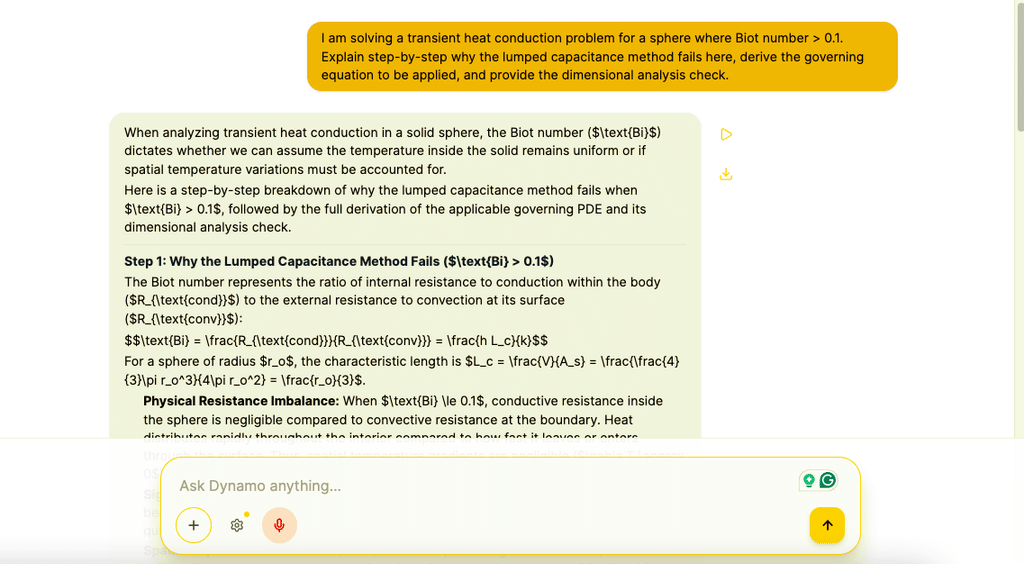
Sample Prompt for Fast Mode:
“In a non-uniform magnetic field varying as B(y) = B0(1 + alpha*y)k_hat, a conducting rod of mass m and length L falls under gravity along the y-axis while sliding friction-free on vertical rails closed by a resistor R. Unpack the equation of motion step-by-step, explain why terminal velocity is asymptotically reached, and check if energy dissipation in the resistor matches the loss in mechanical energy.”
Unpacking Skipping-Step Frustrations
Unlike generic consumer chatbots that produce approximations or wordy prose, Dynamo AI’s engine formats rigorous mathematical logic step by step:
- Explicit First-Principles Grounding: Dynamo AI starts with foundational laws (Newton’s Second Law, Faraday’s Law, Maxwell’s boundary relations) rather than plug-and-chug shortcuts.
- Intermediate Calculation Verification: If a coaching solution skips an algebraic simplification or an unusual substitution in an indefinite integral, Fast Mode isolates and displays that exact calculation.
- Dimensional & Limiting-Case Validation: Dynamo AI tests extreme conditions (e.g., $t \to 0$, $t \to \infty$, or $m \to 0$) to show why an answer is physically sound.
By using Fast Mode as a verification tool rather than an answer cheat, you bridge conceptual blindspots within seconds and move forward with clarity.
Mastering Organic Chemistry and Physics Chains Using Mindmaps
A primary reason students drop marks in JEE Advanced Chemistry and Physics is the inability to track multi-stage causal chains.
- In Organic Chemistry, an Advanced question rarely asks for a single transformation. It asks for a 6-step sequence: an aldol condensation followed by ozonolysis, selective reduction, diazotisation, and a rearrangement reaction.
- In Physics, a thermodynamics cycle is linked to mechanical piston oscillations and damped simple harmonic motion.
Flat, linear notebook pages cannot represent these interconnected relationships.

Operationalizing Dynamo AI Concept Maps
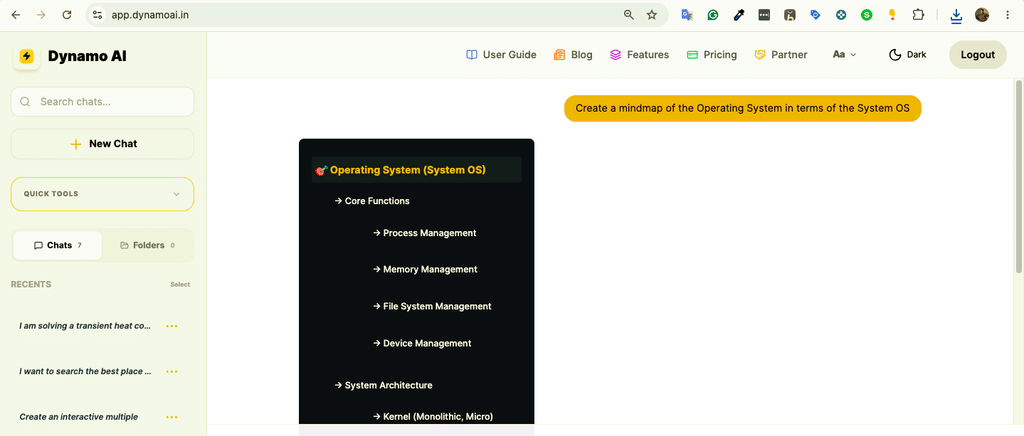
With Dynamo AI, you can convert dense chapters, research summaries, and reference texts into interactive, multi-tiered visual structures:
- Root Nodes: Identify the foundational substrate or theorem (e.g., Aldehydes, Ketones & Carboxylic Acids or Conservation of Angular Momentum).
- Mechanism Branches: Map the exact conditions that dictate branch pathways (e.g., Acid-catalysed vs. Base-catalysed enolisation; Kinetic vs. Thermodynamic enolate control).
- Condition Leaves: Highlight critical JEE traps (e.g., Steric hindrance preventing bimolecular nucleophilic substitution; solvent effects favoring $S_N1$ over $E2$).
When you review your subjects as structured topological trees rather than endless paragraphs, your spatial memory takes over. Under exam pressure, you instantly trace the correct pathway through complex multi-step problems.
Active Recall on Command: Smart Flashcards for Inorganic Chemistry & Math Shortcuts
norganic Chemistry and specialized Mathematics identities are notorious for syllabus decay. A student can understand Coordination Compounds or Conic Sections perfectly in July, yet forget colour changes, spin-only magnetic moments, or hyperbola director circle equations by November.
Relying on passive highlighting guarantees retention loss. Active recall paired with spaced repetition is the only statistically validated methodology for permanent long-term retention.
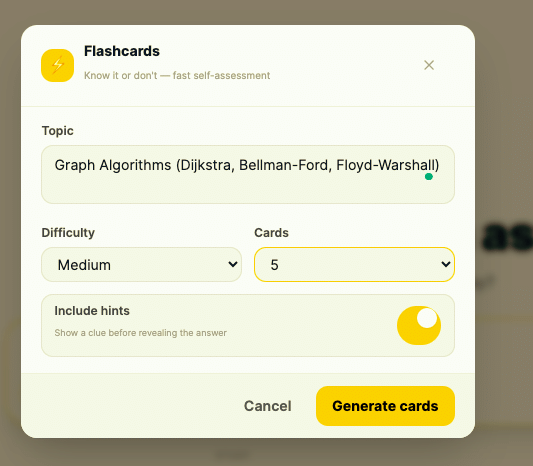
Transforming Reference Data into Active Flashcards
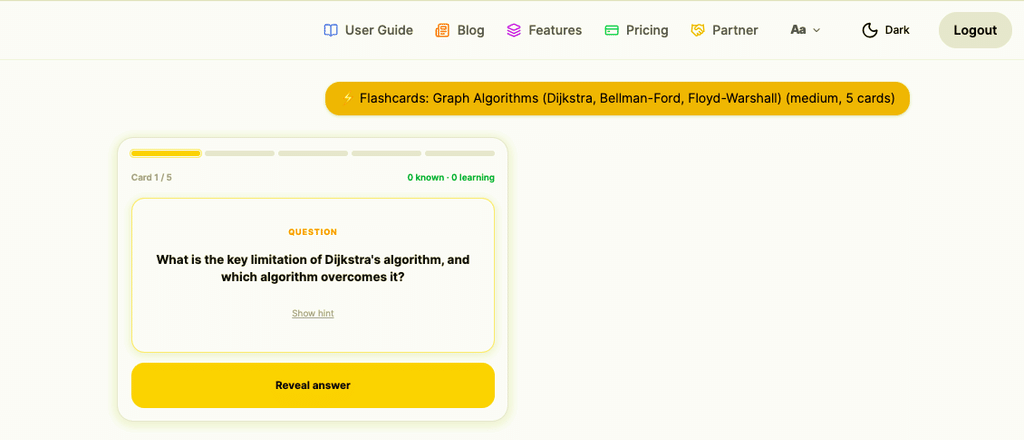
Instead of wasting dozens of hours hand-cutting index cards, Dynamo AI allows you to transform uploaded PDF notes into automated active recall decks:
| JEE Domain | Passive Method (Low Retention) | Dynamo AI Active Recall Method |
| Inorganic Chemistry (p-block, d-block) | Reading reaction tables repeatedly. | Question cards presenting reaction conditions; you predict precipitate colours and evolved gases before flipping. |
| Organic Named Reactions | Memorising finished reaction diagrams. | Cloze-deletion flashcards testing specific reagents, temperature bounds, and stereochemical outcomes. |
| Coordinate Geometry & Calculus | Browsing lists of standard formulas. | Edge-case scenario cards (e.g., “What is the condition for two circles to intersect orthogonally?”). |
Sample Flashcard Prompts for Dynamo AI:
- “Generate a 20-card active recall deck on Coordination Chemistry isomerism (linkage, ionization, geometrical, optical), focusing on octahedral complexes with bidentate ligands.”
- “Create 15 flashcards for Definite Integration properties, specifically edge-case applications of King’s Property and Leibniz Rule of differentiation under the integral sign.”
By dedicating 20 focused minutes every morning to your Dynamo AI flashcard queue, you lock essential facts and formulas into long-term memory permanently.
Diagnostic Custom Quizzes: Testing Edge Cases and Multi-Correct Formats
Solving previous years’ questions (PYQs) is an essential baseline, but relying on them alone creates a false sense of security. Because you have often seen PYQs dissected in lectures, solving them is frequently an exercise in recognition rather than genuine analytical thinking.
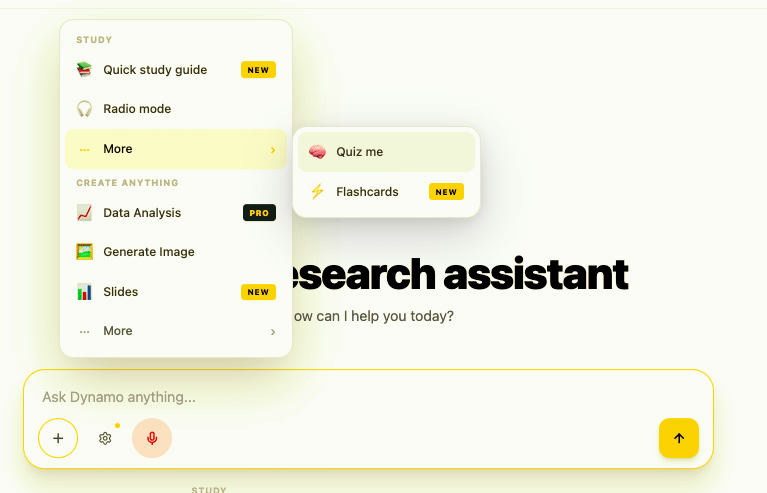
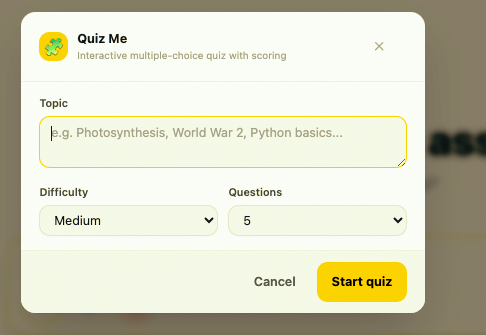
Dynamo AI’s Diagnostic AI Quizzer creates original, unseen problems specifically tailored to test boundary conditions and edge cases.
Calibrating Your Diagnostic Sessions
- Multi-Correct Matrix Engineering: Prompt Dynamo AI to create questions where every option tests a completely different angle of a physical principle:
- “Create an Advanced-level Physics problem on electromagnetic induction featuring a sliding loop entering an inhomogeneous field. Write 4 options (A, B, C, D) testing terminal velocity, total heat generated, induced charge flow, and force balance at intermediate times.”
- Trap Identification & First-Principle Diagnostics: When you select an incorrect option during a quiz session, Dynamo AI does not simply show an answer key. It acts as a personal mentor, analysing where your reasoning broke down:
- Did you overlook an implicit frame-of-reference pseudo force?
- Did you misapply conservation of energy in an open system where work was done by internal non-conservative forces?
- Did you forget to account for an acidic hydrogen during an organometallic Grignard reaction?
The 7-Day High-Performance JEE Advanced Workflow with Dynamo AI
To integrate these capabilities into your daily coaching and self-study schedule, follow this structured weekly cadence:
[Monday – Tuesday: Concept Acquisition & Doubt Resolution]
- Attend core lectures and study standard reference texts (e.g., Irodov, Morrison & Boyd).
- Use Fast Mode to instantly resolve sticky intermediate derivations and analytical doubts.
- Map newly introduced multi-concept topics into visual Dynamo AI Mindmaps.
[Wednesday – Thursday: Active Recall Integration]
- Convert your formula notebooks and qualitative reaction tables into Dynamo AI Flashcards.
- Complete a 20-minute Spaced Repetition session every morning to combat syllabus decay.
- Solve advanced problem sets, using Fast Mode only after giving each problem an honest 15-minute attempt.
[Friday – Saturday: Stress-Testing & Diagnostic Quizzing]
- Run the Diagnostic Quizzer on Multi-Correct and Matrix-Match modes for current and backlog units.
- Conduct an error audit: feed incorrect derivations back into Dynamo AI to isolate misconceptions.
[Sunday: Macro-Synthesis & Consolidation]
- Review your subject Mindmaps to ensure cross-chapter linkages remain sharp.
- Run a consolidated flashcard review across all cumulative decks.
Conclusion: Power Your Curiosity — Transitioning from Memoriser to Problem Solver
JEE Advanced is not a test of memory; it is a test of intellectual resilience and foundational mastery. The students who earn top ranks at the IITs are not those who memorized the most shortcuts, but those who developed the intellectual curiosity to ask: Why does this equation hold? What happens if this constraint changes? How does this concept connect to first principles?
Dynamo AI is designed to support that exact scientific mindset. By removing administrative friction, eliminating unproductive doubt-solving bottlenecks, and turning passive reading into an active, visual dialogue, you unlock your true problem-solving capacity.
Power Your Curiosity. Stop getting stuck on tricky steps, master your conceptual foundations, and take control of your JEE Advanced journey with India’s leading AI Research OS.
Ready to transform your JEE Advanced preparation?
Stop losing hours to unexplained solutions and fragmented notes. Launch Dynamo AI today and experience the speed of Fast Mode on your toughest physics derivations.