

Table of Contents
Securing a Junior Research Fellowship (JRF) or qualifying for Assistant Professorship via the Council of Scientific and Industrial Research (CSIR) NET or University Grants Commission (UGC) NET represents a critical gateway in Indian academia. It unlocks national-level fellowships, doctoral admissions in premier institutes (IITs, IISERs, Central Universities), and tenure-track eligibility.
Yet, the exam poses a structural dilemma: candidates must excel in general analytical logic and pedagogical aptitude while demonstrating deep, research-grade mastery in their specialised discipline.
Traditional coaching institutes rely on voluminous static binders and rote memorisation. However, modern NET question papers increasingly feature multi-layered assertions, reasoning-based evaluations, and experimental data interpretation.
Dynamo AI, India’s #1 AI Research OS, replaces passive skimming with an active research environment. By combining automated literature synthesis, interactive concept mapping, dynamic active recall, and diagnostic testing, candidates can dramatically reduce revision cycles while building true conceptual depth.
Here is your actionable blueprint to conquer UGC and CSIR NET with Dynamo AI and Power Your Curiosity.
Cracking the JRF Cutoff: The Dual Challenge of Paper 1 and Domain Papers
Qualifying for Lectureship (LS) requires solid preparation, but clearing the JRF threshold requires absolute precision. The cutoff variance between LS and JRF is often as narrow as 2% to 4%, meaning every single mark across both segments counts:
- Paper 1 (General Paper on Teaching & Research Aptitude): 50 compulsory questions testing teaching methodology, research methods, data interpretation, mathematical reasoning, ICT, and higher education policy. Aspirants with brilliant subject knowledge frequently miss their JRF due to underperforming on Paper 1.
- Paper 2 / Domain Sciences (CSIR Part B & C / UGC Paper 2):
- In CSIR NET (Part C), questions test deep analytical reasoning where candidates must select 25 out of 75 high-value questions based on experimental protocols, molecular diagrams, or reaction pathways.
- In UGC NET, candidates face 100 domain-specific questions requiring comprehensive cross-thematic understanding across dozens of historical or modern schools of thought.
The volume of syllabus material is immense. When candidates attempt to read standard monographs cover-to-cover during the final six months, cognitive fatigue sets in. What is required is not merely more hours of reading, but a system that accelerates comprehension, organizes conceptual hierarchies, and isolates knowledge gaps.
Conquering Paper 1: Quick Study Guides for Research Aptitude and Teaching Methodology
Paper 1 tests conceptual application rather than memorisation. Questions demand an exact understanding of experimental validity, sampling biases, parametric versus non-parametric tests, and evolving higher education regulatory bodies (such as NEP 2020 initiatives).
Dynamo AI’s Quick Study Guide feature condenses sprawling educational and research literature into structured, high-yield revision tables.
Sample Prompt for Dynamo AI:
“Generate a Comparative Analysis Table for Paper 1 Research Aptitude on Probability vs Non-Probability Sampling Methods. Include: Definition, Specific Sub-types (Stratified, Systematic, Snowball, Quota), Real-World Example, and CSIR/UGC NET Common Trap Statements.”
Structured Research Aptitude Matrix Generated by Dynamo AI
| Research Concept | Core Principle | Sub-Types & Distinctions | Frequent NET Exam Traps |
| Probability Sampling | Every unit has a non-zero, equal chance of selection; enables statistical generalisability. | Simple Random, Stratified (homogeneous strata), Cluster (heterogeneous clusters), Systematic ($k$-th interval). | Conflating Stratified Sampling (random selection within strata) with Quota Sampling (convenience selection). |
| Non-Probability Sampling | Selection based on subjective judgment, accessibility, or specific quotas; non-generalisable. | Purposive (judgmental), Snowball (referral/hard-to-reach groups), Quota, Convenience. | Assuming Snowball sampling can be subjected to parametric $t$-tests without violating distributional assumptions. |
| Type I vs Type II Errors | $\alpha$ error: False Positive (rejecting true null). $\beta$ error: False Negative (failing to reject false null). | Power of test = $1 – \beta$. Level of significance = $\alpha$. | Believing lowering $\alpha$ simultaneously lowers $\beta$ without increasing sample size $n$. |
By generating these compact comparative modules directly inside Dynamo AI, you eliminate the ambiguity that routinely causes students to drop marks on straightforward conceptual questions.
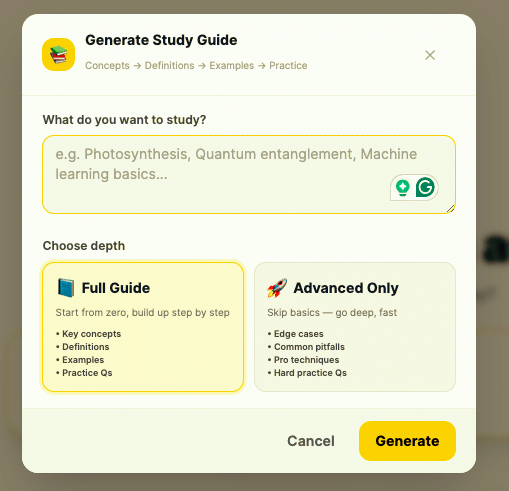
Managing Massive Syllabi: Comprehensive & Advanced Guides for Domain Papers
Whether your focus is Molecular Genetics and Biochemistry in CSIR Life Sciences, Coordination Chemistry in Chemical Sciences, or Microeconomic Equilibrium in UGC NET Commerce/Economics, surface-level definitions are insufficient. Part C of CSIR NET demands experimental and hypothetical problem-solving.
Dynamo AI’s Comprehensive & Advanced Guide mode allows you to upload authoritative research papers, review articles, and textbook chapters (e.g., Lodish for Cell Biology, Huheey for Inorganic Chemistry, or Koutsoyiannis for Microeconomics) to generate research-grade syntheses.
Example: CSIR NET Part C Experimental Breakdown
When studying the CRISPR-Cas9 genome editing mechanism, passive reading leaves you unprepared for experimental knockout interpretation questions. Using Dynamo AI, you can unpack the mechanism systematically:
- Target Identification & sgRNA Design: PAM sequence requirements ($5’\text{-NGG-3′}$) and off-target cleavage prediction.
- Double-Strand Break (DSB) Repair Pathways: Non-Homologous End Joining (NHEJ, error-prone, indels) vs. Homology-Directed Repair (HDR, precise template-based knock-in).
- Diagnostic Readouts: Southern blotting, Surveyor nuclease assay, and Western blot validation.
Instead of hunting across four different textbooks and three review articles, Dynamo AI synthesises the entire cascade into a clear, stepwise analysis complete with experimental controls and potential artefacts.
Visualising Mechanisms and Classifications with Dynamo Mindmaps
A major hurdle in domain papers is topological and procedural complexity. The human brain does not easily process multi-tier biochemical cascades, metabolic cycles, or historical political movements as flat text on a printed page.
Dynamo AI’s Visual Concept Mindmaps map these non-linear interconnections automatically.
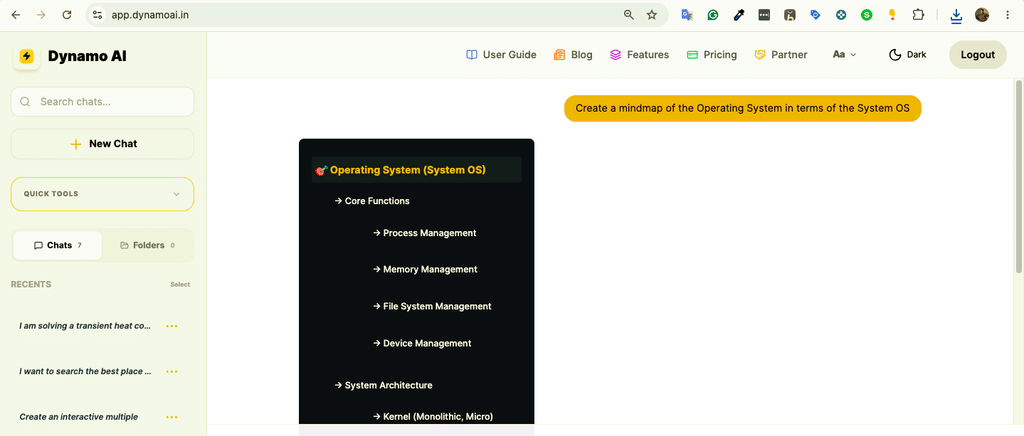

Practical Mindmap Workflows for NET Disciplines
- Life Sciences (CSIR): Map signal transduction pathways (e.g., Receptor Tyrosine Kinases $\rightarrow$ Ras-MAPK cascade $\rightarrow$ transcription factor phosphorylation $\rightarrow$ cell proliferation) with dedicated branches denoting kinase inhibitors.
- Chemical Sciences (CSIR): Construct symmetry and point-group decision trees ($C_{nv}$, $D_{nh}$, $T_d$, $O_h$) alongside character table applications for vibrational spectroscopy.
- Humanities & English Literature (UGC): Chart literary theories (Structuralism $\rightarrow$ Post-Structuralism $\rightarrow$ Deconstruction) cross-referenced with primary theorists, core texts, and publication years.
- Management & Commerce (UGC): Diagram capital structure theories (Net Income Approach, Net Operating Income, Modigliani-Miller Theorem with and without taxes).
By reviewing visual nodes instead of paragraphs, you build spatial memory representations of complex topics. When a multi-statement question appears on screen, your brain navigates the mental branch instantly.
Active Recall via AI Flashcards: Formulae, Named Cycles, and Chronologies
The NET syllabus demands recall of arbitrary markers: IUPAC names, organism taxons, standard enzyme constants ($K_m$, $V_{max}$), treaty dates, institutional foundation years, and constitutional articles. Passive re-reading is an unreliable strategy for retaining arbitrary data points over an 8-month period.
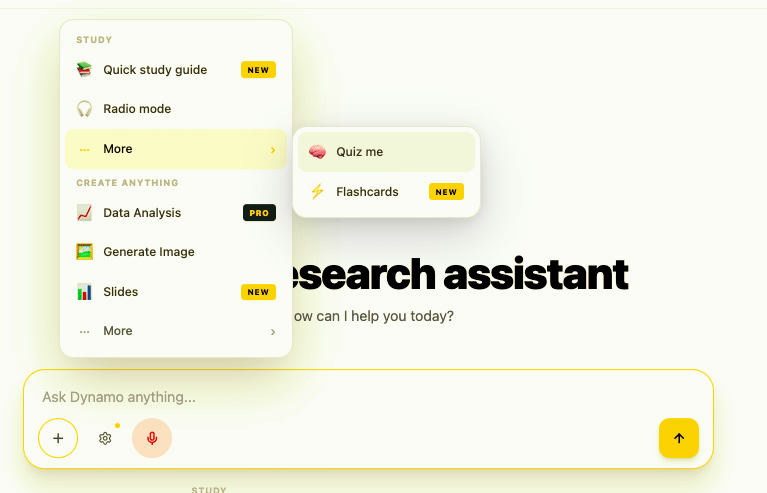
Dynamo AI’s Smart Flashcards generate high-density active recall decks directly from your study guides, structured for automated spaced repetition.
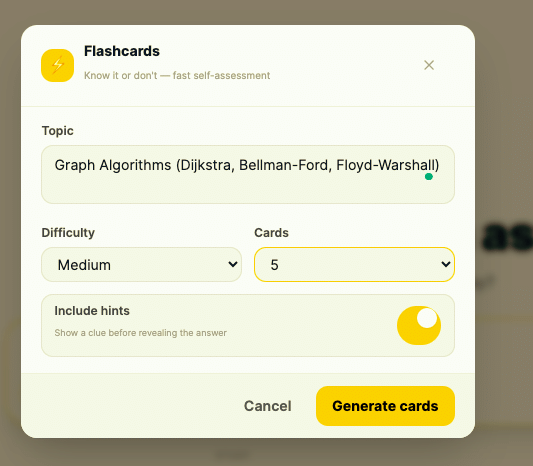
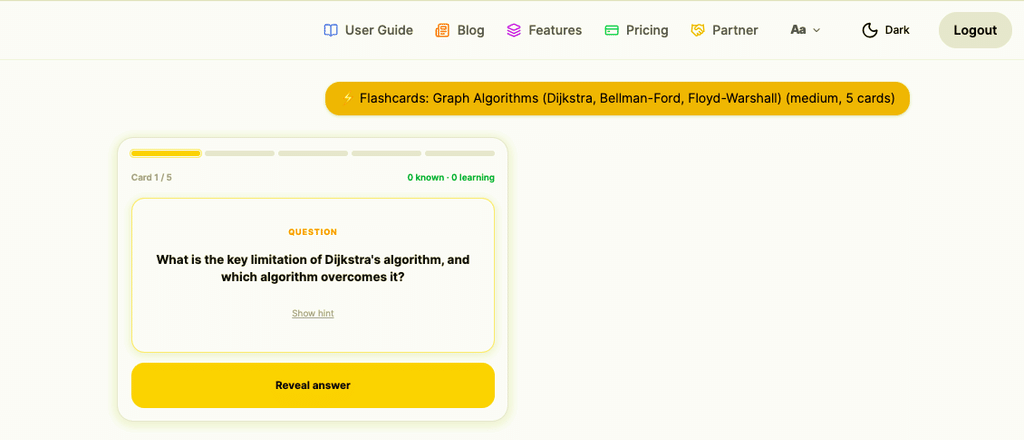
Sample Flashcard Deck Prompts for Dynamo AI:
- “Extract 20 cloze-deletion flashcards from this chapter on Glycolytic and TCA enzymes, testing their allosteric activators, inhibitors, and co-factor dependencies.”
- “Generate 15 flashcards for UGC NET Paper 1 Higher Education, matching commissions (Radhakrishnan, Mudaliar, Kothari, Sam Pitroda) with their major policy recommendations.”
Instead of spending weeks manually preparing cards on paper, you can generate comprehensive, error-free decks within seconds. Regular 20-minute daily sessions ensure that formulas, dates, and taxonomies remain fresh right up to exam day.
Dynamic Paper 1 & 2 Quizzing: Diagnosing Blindspots
Solving past-year questions (PYQs) is essential, but PYQs only test what has already been asked. High-scoring candidates prepare for the permutations of what could be asked next.
Dynamo AI’s Diagnostic AI Quizzer creates targeted question sets calibrated to the exact cognitive level of CSIR and UGC NET:
- Assertion-Reasoning Sets (Paper 1 & Paper 2):Dynamo AI crafts tricky Assertion (A) and Reason (R) combinations, forcing you to determine not only if both statements are independently true, but whether (R) is the genuine causal explanation for (A).
- Experimental Interpretation (CSIR Part C):Generate hypothetical gel electrophoresis, SDS-PAGE, or Lineweaver-Burk plots and challenge yourself to deduce enzyme kinetics or genetic deletions.
- Multi-Statement Match-the-Following (UGC Paper 2):Practice cross-disciplinary matching questions where four distinct authors, concepts, or formulas must be aligned simultaneously.
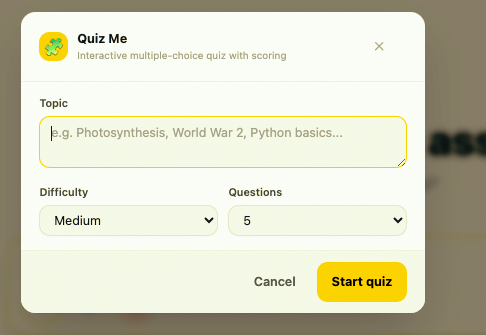
Diagnostic Feedback Loop:
When you submit an incorrect answer, Dynamo AI doesn’t just state “Option B is correct.”
It pinpoints:
- The exact logical error in your reasoning.
- The specific theoretical principle you overlooked.
- A tailored follow-up question to verify that the blindspot is eliminated.
The 5-Phase NET Prep Framework Powered by Dynamo AI
To organise your study timeline across a 6-month cycle, deploy this structured framewor
Phase 1: Deep Ingestion (Months 1–2)
- Upload core reference materials and official syllabi into Dynamo AI.
- Generate Comprehensive Study Guides for each unit.
- Construct subject-wide Visual Mindmaps to build the structural roadmap.
Phase 2: Paper 1 Routine Integration (Months 3–4)
- Build Quick Study Guides for Research & Teaching Aptitude.
- Generate daily 15-minute flashcard drills on ICT, Environment, and Higher Ed policies.
- Run 10-question daily diagnostic mini-quizzes in Paper 1.
Phase 3: Part C / Advanced Domain Mastery (Month 5)
- Upload experimental papers and advanced problems into Dynamo AI.
- Use Fast Mode for immediate, step-by-step doubt resolution on complex proofs or pathways.
- Generate scenario-based experimental questions via the Diagnostic Quizzer.
Phase 4: Spaced Recall & Trap Identification (Final 30 Days)
- Review Mindmap leaf nodes every morning.
- Run automated Flashcard decks on edge cases, constants, dates, and formulas.
- Diagnose remaining blindspots with timed, full-length custom mock sets.
Phase 5: The Exam Room Execution
- Walk in with verified conceptual clarity, rapid recall pathways, and zero reliance on guesswork.
Conclusion: Power Your Curiosity — From Aspirant to Fellow
The journey toward qualifying CSIR or UGC NET is not merely an exercise in exam survival; it is your initiation into the national research ecosystem. The intellectual habits you develop today—structured analysis, rapid information processing, critical evaluation of evidence, and conceptual synthesis—form the foundation of your future career as a researcher or professor.
Stop drowning in fragmented PDFs, unorganized handwritten notes, and outdated guidebooks. Upgrade your preparation to India’s dedicated AI Research OS.
Power Your Curiosity. Turn the vast NET syllabus into an organised, interconnected network of knowledge, and step into the examination hall with absolute confidence.
Supercharge Your CSIR & UGC NET Preparation Today
Take the guesswork out of Paper 1 and domain revisions. Build your first custom study guide, flashcard deck, or concept mindmap with Dynamo AI now.