
Table of Contents
Preparing for GATE isn’t just about how many hours you clock—it is about how efficiently you synthesise years of complex engineering syllabi into operational problem-solving speed. Between deciphering intricate derivations and retaining hundreds of design formulas, traditional rote learning often leads to cognitive fatigue long before exam day.
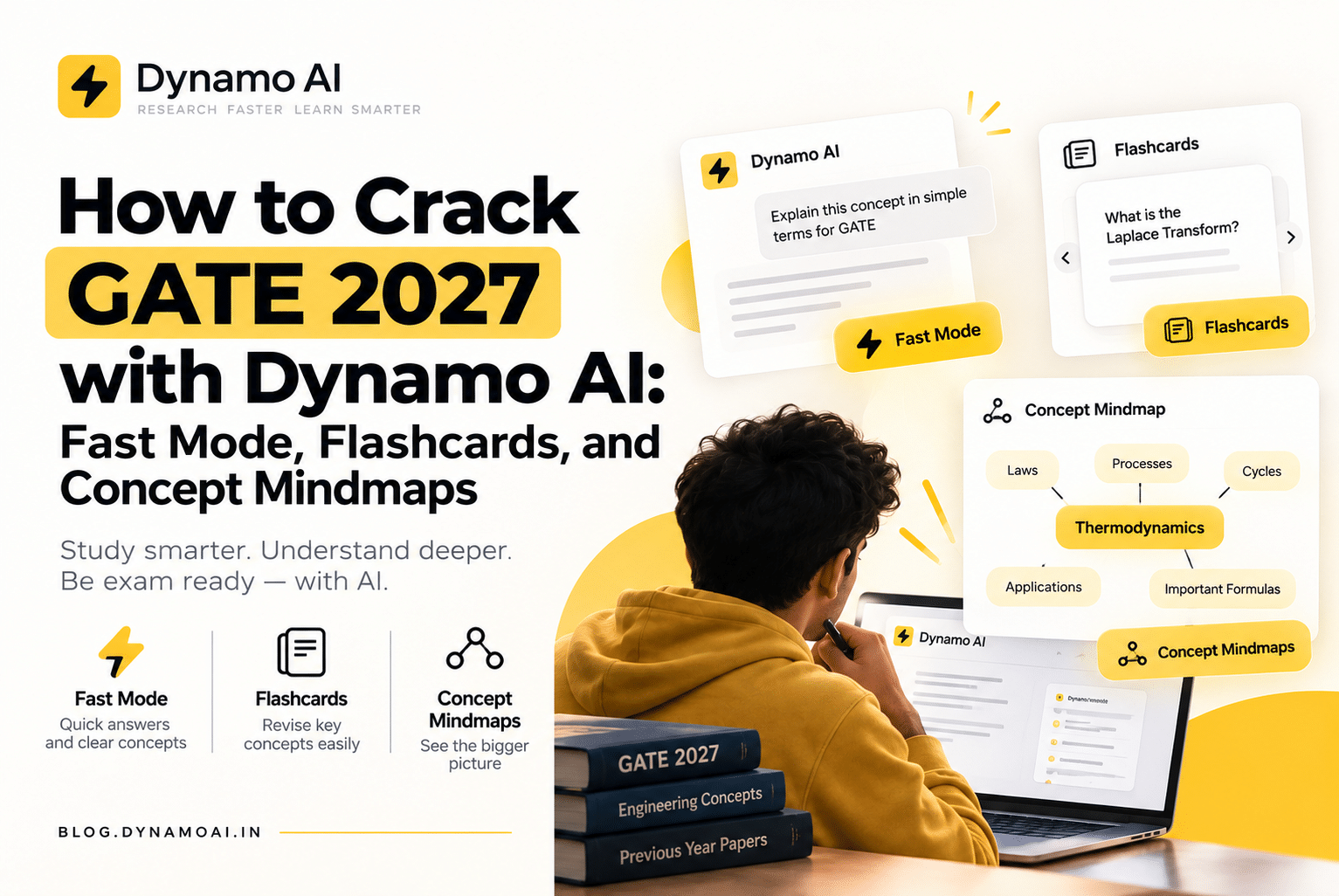
As India’s premier AI Research OS, Dynamo AI transforms your prep from passive cramming into an accelerated, active-recall workflow. Whether you need instant numerical breakthroughs with Fast Mode, automated formula retention via Smart Flashcards, or high-level clarity through interactive Concept Mindmaps, here is how you can systematically master GATE 2027 and Power Your Curiosity from day one.
The Scale of GATE: Why Brute-Force Cramming Fails Engineering Aspirants
Every year, hundreds of thousands of engineering graduates across India compete in the Graduate Aptitude Test in Engineering (GATE). Whether your ambition is a seat at IISc, an IIT Master’s programme, direct recruitment into a Maharatna PSU (such as ONGC, IOCL, or NTPC), or securing a fellowship for direct PhD admissions, one truth quickly becomes evident: GATE is not an exam you can conquer through rote memorisation.
The syllabus for any major discipline—be it Computer Science (CS), Mechanical (ME), Electrical (EE), Electronics and Communication (EC), or Civil Engineering (CE)—spans three to four years of rigorous undergraduate coursework. Add to this the distinct, unforgiving architecture of the GATE question paper:
- Multiple Choice Questions (MCQs) with negative marking to punish guesswork.
- Multiple Select Questions (MSQs) requiring absolute conceptual completeness across four separate options.
- Numerical Answer Type (NAT) questions with zero tolerance for rounding errors or superficial formula recall.
Traditional preparation methods collapse under this weight. Reading 800-page standard textbooks cover-to-cover leaves aspirants with cognitive fatigue and poor retention. Highlighted PDFs rarely translate into operational problem-solving ability under real-time exam conditions.
To bridge the gap between understanding theory and solving novel, multi-concept problems, you need an active, structured system. This is where Dynamo AI, India’s dedicated AI Research OS, transforms preparation from passive cramming into an accelerated, high-retention discovery loop.
Instant Numerical Breakthroughs: Fast Mode for High-Speed Doubt Resolution
Every GATE aspirant knows the dreaded “friction point”: you are working through an intricate numerical problem in the middle of a late-night study session, and you get stuck on step four of an eight-step derivation. Searching online forums or scouring video lectures eats up 45 minutes, breaks your cognitive flow, and drains your energy.
Unpacking Bottlenecks with Dynamo AI Fast Mode
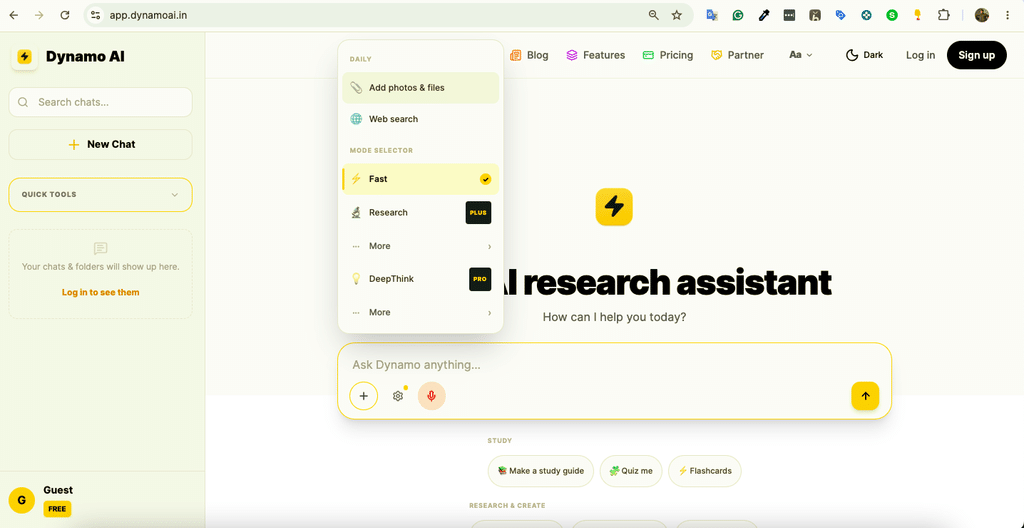
Dynamo AI’s Fast Mode is engineered specifically for instantaneous, latency-free technical queries. Unlike generic consumer chatbots that produce vague, conversational prose, Fast Mode functions like an on-demand technical mentor:
- Thermodynamics & Heat Transfer: Instantly resolve boundary-condition ambiguities in steady-state conduction, polytropic expansion indices, or psychrometric calculations.
- Signals & Systems / Network Theory: Clarify region of convergence (ROC) conflicts in Z-transforms, or verify state-space matrix conversions in seconds.
- Data Structures & Algorithms: Debug recurrence relations using the Master Theorem or step through complex red-black tree rotations.
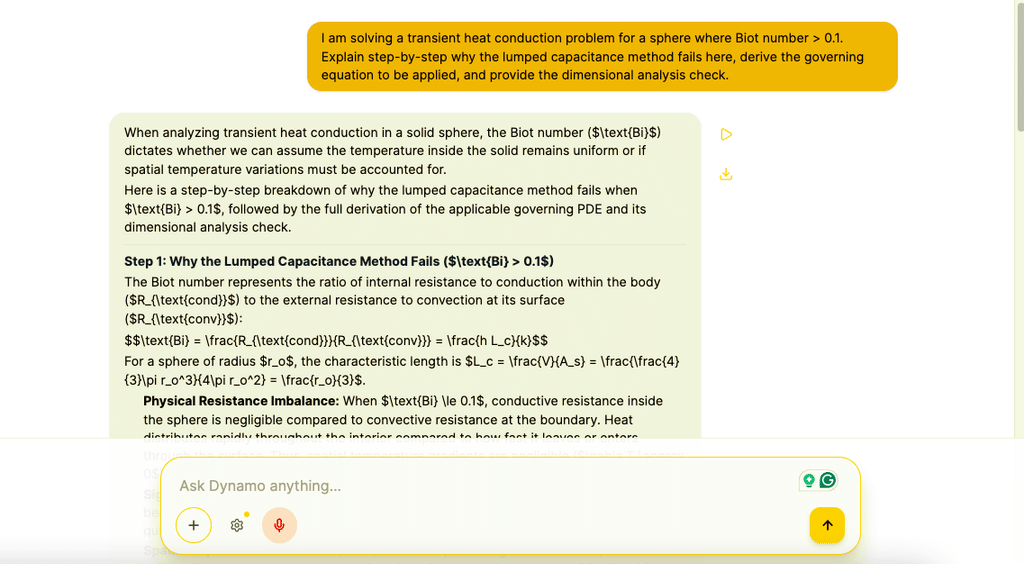
Example Prompt for Fast Mode:
“I am solving a transient heat conduction problem for a sphere where Biot number > 0.1. Explain step-by-step why the lumped capacitance method fails here, derive the governing equation to be applied, and provide the dimensional analysis check.”
Deep Architectural Learning: Turning Heavy Standard Textbooks into Concept Mindmaps
Standard engineering reference books are indispensable for GATE. You cannot replace Galvin for Operating Systems, Korth for Database Systems, Ogata for Control Systems, or Shigley for Mechanical Engineering Design. However, their sheer density often prevents students from seeing the big picture.
A major reason students struggle with multi-chapter MSQs is that they view concepts as isolated silos rather than an interconnected system.

Moving Beyond Linear Notes
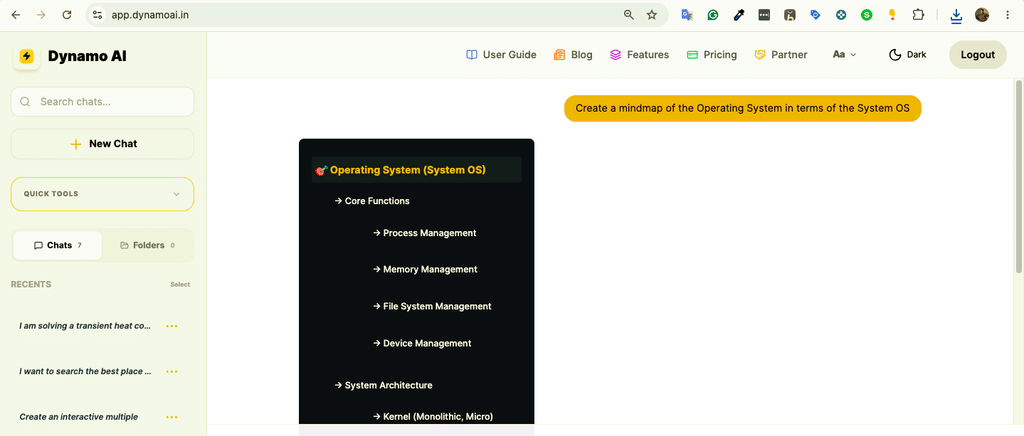
Dynamo AI allows you to upload standard PDF texts, research papers, and technical lecture slides directly into your workspace. Using built-in Visual Mindmap Generation, Dynamo AI extracts core theoretical structures and organizes them into navigable, multi-tiered visual diagrams:
- Top-Level Nodes: Identify primary domains (e.g., Eigenvalues & Eigenvectors in Linear Algebra).
- Intermediate Branches: Map secondary constraints (e.g., Hermitian, Skew-Hermitian, Unitary Matrix Properties).
- Leaf Nodes: Pin specific GATE traps (e.g., Conditions under which algebraic multiplicity equals geometric multiplicity).
By reviewing mindmaps before diving into numerical sets, your brain maps the complete problem space. When faced with a complex MSQ requiring knowledge from both Control Systems and Linear Algebra, your recall pathways trigger seamlessly.
Retaining 500+ Formulae: Auto Flashcards and Spaced Repetition
The GATE syllabus requires rapid, accurate recall of hundreds of mathematical identities, empirical constants, thermodynamic relations, and material property tables. Forgetting a single negative sign or power index turns a correct 5-minute derivation into a negative score.
Common Challenge:
Week 1: Master Fourier Transforms.
Week 4: Shift focus to Probability and Calculus.
Week 8: Discover that 60% of Fourier Transform identities have decayed from memory.
The Solution: Automated Technical Flashcards
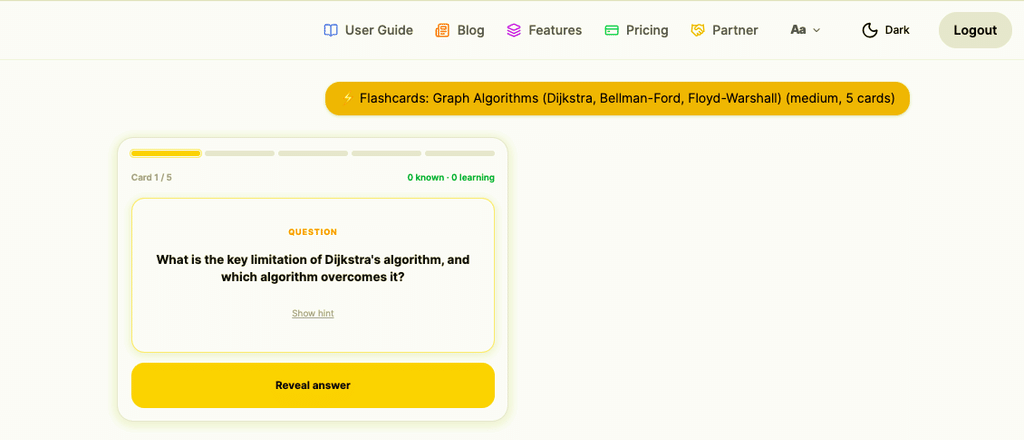
Instead of spending hours manually hand-writing physical index cards, you can deploy Dynamo AI’s Auto-Flashcard Generator over your lecture summaries or reference chapters.
| Study Asset | Traditional Approach | Dynamo AI Active Recall Method |
| Formula Retention | Re-reading highlighted formula notebooks passively. | Dynamic flashcards presenting the problem scenario; you predict the formula before flipping. |
| Edge Cases & Traps | Memorising solved examples. | Cloze-deletion flashcards testing boundary limits (e.g., $Re < 2300$ for pipe laminar flow). |
| Revision Cycles | Unstructured, sporadic revisions. | Algorithmic spaced-repetition prompts targeting only your weakest topics. |
Sample Prompts for GATE Card Decks
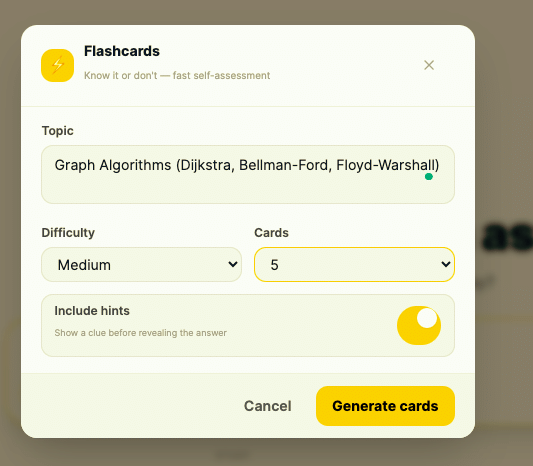
- “Generate a 15-card active recall deck on Maxwell’s Equations and Electromagnetic Boundary Conditions, focusing specifically on interface transitions between dielectric media.”
- “Create flashcards for all time and space complexities of Graph Algorithms (Dijkstra, Bellman-Ford, Floyd-Warshall), including edge-case behaviour with negative cycles.”
Simulated Stress Testing: The Dynamo AI Diagnostic Quizzer
Practicing previous years’ questions (PYQs) is mandatory, but PYQs alone are insufficient for modern GATE papers. The conducting IITs routinely formulate novel problem configurations designed to test whether you understand first principles or merely memorised earlier patterns.
Dynamo AI features a specialised Diagnostic Quizzer that crafts original, exam-calibrated questions from your study materials.
Creating Exam-Standard Challenges
- NAT Simulation (Numerical Answer Type):Prompt Dynamo AI to generate numerical questions requiring precise calculation without multiple choices to guide you:
- “Create 3 NAT problems on B-Tree order and split mechanisms. Calculate the maximum number of keys in a 4-level B-tree.”
- MSQ Calibration (Multiple Select Questions):MSQs demand absolute mastery because selecting 3 out of 4 correct options still yields zero marks.
- “Generate 2 MSQ problems on Eigenvalues of orthogonal matrices where multiple abstract mathematical statements are evaluated.”
- Step-by-Step Diagnostic Feedback:When your computed answer diverges from the result, Dynamo AI does not simply display the final value. It breaks down the derivation line-by-line, pointing out whether your mistake was algebraic, dimensional, or conceptual.
A Structured 7-Day GATE Prep Workflow with Dynamo AI
To demonstrate how these features integrate into your day-to-day schedule, here is a practical weekly cadence for any core technical subject:
[Monday – Tuesday]
- Upload standard textbook chapters & notes into Dynamo AI.
- Generate a Visual Mindmap to understand the topical architecture.
- Use Fast Mode to resolve doubts during first-pass textbook reading.
[Wednesday – Thursday]
- Run the Auto-Flashcard generator on formulas, properties, and proofs.
- Spend 30 minutes each morning running active-recall drills.
- Solve standard textbook problem sets alongside Fast Mode for derivation checks.
[Friday – Saturday]
- Launch the Diagnostic Quizzer in NAT & MSQ modes.
- Test yourself on edge cases, unusual boundary conditions, and multi-concept questions.
- Feed incorrect answers back into Dynamo AI to diagnose conceptual misconceptions.
[Sunday]
- Review the full subject Mindmap for macro-level recall.
- Run a consolidated flashcard review covering all weekly decks.
Conclusion: Power Your Curiosity — Transitioning from GATE Aspirant to Research Scholar
Cracking GATE is a defining milestone in an Indian engineer’s trajectory. It opens doors to premier institutions, high-impact research laboratories, and core public sector engineering roles. But the mindset required to clear GATE—curiosity, systematic problem-solving, and intellectual independence—is the exact same mindset required for cutting-edge engineering research.
Dynamo AI is purpose-built to support this transition. By automating tedious note-making and replacing passive reading with dynamic mindmaps, fast technical clarity, and diagnostic self-testing, you free up your mental bandwidth to master core concepts deeply.
Power Your Curiosity. Turn your GATE preparation into an inspiring, high-retention discovery journey.
Ready to elevate your GATE 2027 preparation?
Stop losing hours to fragmented searches and disjointed notes. Launch Dynamo AI today and create your first GATE subject mindmap in seconds.